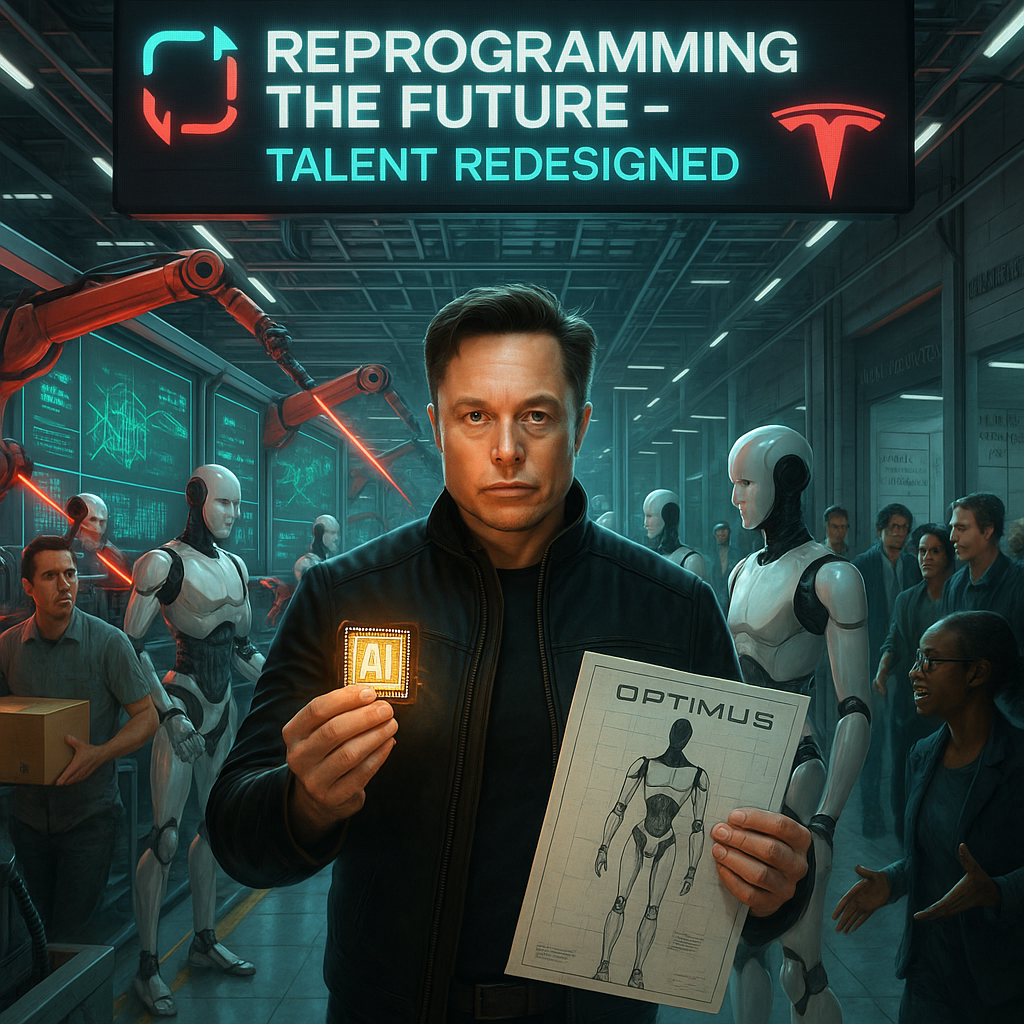
Tesla's silent pivot: Are robots replacing engineers or redefining them ?
In the world of tech innovation, few companies command attention like Tesla. Known for its electric vehicles, bold CEO, and boundary-pushing ambitions, Tesla is once again making headlines but this time, not for its cars or rockets. Over the past few months, the company has quietly laid off thousands of employees, including top-performing engineers, while simultaneously ramping up hiring in AI, automation, and robotics. The result is a shift that raises both eyebrows and fundamental questions: is Tesla replacing human engineers with robots, or is it strategically redesigning its future workforce ?
In April 2024, Tesla announced sweeping layoffs impacting over 10% of its global workforce. Among the hardest hit were engineering departments tied to software, battery systems, and quality control. Notably, the Austin Gigafactory, Tesla’s Texas-based manufacturing hub lost over 2,600 employees, according to local filings. Insiders reported that some of the cuts targeted entire teams, including roles associated with inspection and testing.
At first glance, this might resemble standard corporate restructuring in response to market pressures. But a closer look tells a different story.
Almost immediately after the layoffs, Tesla began posting new job listings. These weren’t for conventional engineering roles. They were for AI specialists, robotics engineers, and machine learning experts roles specifically tied to Tesla’s self-driving Autopilot program, humanoid robot project Optimus, and neural network development. In short, Tesla wasn’t cutting costs. It was reallocating talent.
The most symbolic moment came when Milan Kovac, the head of the Optimus robotics team, left the company. While such a departure could suggest turmoil, it was followed by the high-profile hiring of Henry Kuang, a former Cruise executive and AI leader, to lead Tesla's machine learning division. This leadership transition confirms that Tesla isn’t retreating from engineering, it’s redefining it.
Elon Musk has never hidden his long-term vision. From the very beginning, he envisioned Tesla as more than a car company. Today, it’s positioning itself as a leader in autonomous systems, with a future workforce where robots and AI are not just tools but teammates. Musk’s persistent claims about full self-driving capabilities, humanoid factory robots, and AI-integrated services have often sounded futuristic. Now, they’re beginning to materialize and at a cost to traditional roles.
The pivot was further reinforced when Tesla appointed Raj Jegannathan, an IT executive with no traditional sales background, to lead North American sales. This decision, coming amid wider executive turnover, is telling. It suggests that Tesla values systems thinking and automation strategy over legacy industry knowledge. In other words, AI expertise is now more important than automotive experience.
Yet, while this transformation may excite technologists, it brings significant challenges. Mass layoffs of skilled engineers raise questions about morale, institutional knowledge loss, and ethical responsibility in workforce planning. More critically, this shift touches on a broader societal concern: as AI and robotics mature, how do we define the future role of humans in technology-driven industries ?
Tesla is not the first company to explore automation at scale, but its aggressive execution makes it a case study in real-time. It exemplifies a quiet yet profound transformation sweeping across sectors: the replacement of generalist technical roles with specialized AI-powered systems. What was once a support function is becoming a core competency. AI is no longer an add-on, it’s the engine.
So, is Tesla replacing engineers with robots ? Not exactly. It’s replacing some engineers, yes, but more importantly, it's creating a new kind of engineer: one who understands systems, data, algorithms, and how to design alongside artificial intelligence. Those who adapt will find a place in the new Tesla. Those who don't may find themselves on the outside of a company they once helped build.
As the lines blur between human labor and machine intelligence, Tesla’s evolution is not just a corporate strategy, it’s a glimpse into the future of work. The quiet pivot is complete. The question now is not whether robots will take jobs, but which jobs will be redefined and who gets to lead the next chapter.
Want to discuss this article ? Contact us below.
Thomas DUPORT
thomas.duport@talentedint.com
Chief Operating Officer
Talented International – Artificial Intelligence Recruiting
Barcelona – Berlin – Dublin – Lyon
Phone : +33 1 84 88 97 97
Qui sommes-nous ?

Chez Talented International, nous nous focalisons sur le recrutement dans le domaine du retail et nous nous efforçons de vous accompagner dans la réalisation de vos aspirations professionnelles.
Comptez sur notre équipe pour vous orienter vers une carrière enrichissante et stimulante dans l'univers captivant du retail.
 French
  English