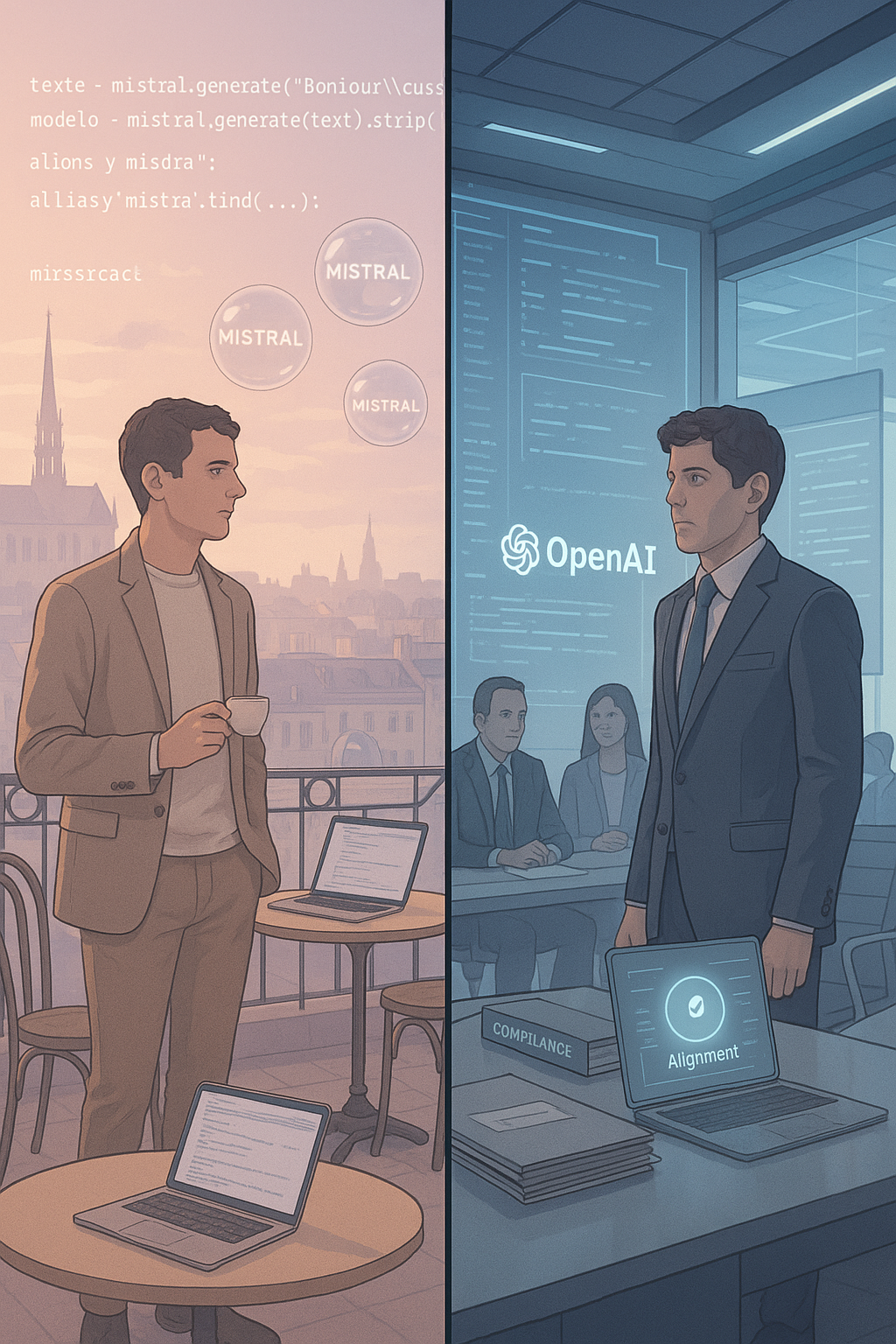
It’s 2025 and a Parisian-born AI startup is making tech giants sweat. Mistral, barely out of its startup cradle, has burst onto the scene with language models that are not only open-source and powerful but come with a distinctly European confidence that’s making Silicon Valley nervous. The rules of the AI game are shifting and for the first time in a while it’s not the Bay Area setting the pace.
OpenAI has long been the standard, the name, the benchmark, the API you plug in when you want power with polish. It’s the tech industry’s polite monopoly, offering GPT models wrapped in clean UX and safety disclaimers. Then comes Mistral with models that are fast, lean, multilingual, and unapologetically open. Not open like you can use our API for a fee, but open like here’s the whole thing, weights and all, good luck. It’s not just a different philosophy. It’s a challenge. And the Valley hears it loud and clear.
What makes Mistral so dangerous isn’t just its performance. It’s the attitude. No blog posts full of hand-wringing. No San Francisco humility cosplay. Mistral’s founders aren’t trying to align with human values before pushing code. They’re releasing models that perform as well as the biggest players without the bloat, the bureaucracy, or the PR fluff. It’s technical elegance with a bit of European edge and it’s landing like a punch in a room full of over-engineered AI wrappers.
The fear isn’t just that Mistral works. It’s that it works differently. OpenAI and Google DeepMind operate with the weight of empires, structure, red tape, policy teams, partnership announcements, board drama. Mistral operates like a gang of brilliant underdogs with nothing tolose. They don’t need 100 PhDs to ship a model. They just ship. And when they do the benchmarks speak louder than any tweet thread.
Culturally, Mistral is a flex. It’s a reminder that innovation doesn’t have to wear a Patagonia vest and bike to work in Mountain View. It can sip espresso, speak fluent Python and English and French, and still beat you at your own game. In a landscape saturated with American optimism Mistral brings a dose of sharp European pragmatism, models that are fast, transparent, and capable of holding their own without billion-dollar marketing campaigns.
There’s also the geopolitical edge. Europe has been treated like a cautious spectator in the AI arms race. Regulations here, frameworks there, but not much firepower until now. Mistral is showing that Europe can play offense. That France, of all places, can lead on speed, scale, and sophistication in AI. And suddenly the monopoly narrative is broken. It turns out you don’t need atrillion-dollar cloud service to build great models. You just need the will to disrupt.
OpenAI won’t vanish. It’s still the name that opens doors and the platform with the widest reach.
But the illusion of unchallenged dominance is gone. Now there’s competition with real teeth and
it’s not coming from within Silicon Valley. It’s crossing the Atlantic with a GitHub repo in one hand
and a quiet smirk in the other.
So do you need to be French to scare Silicon Valley ? Not necessarily. But it helps if you act like
you’ve got nothing to prove and everything to build. That’s the Mistral way and it’s working.

 English
  French