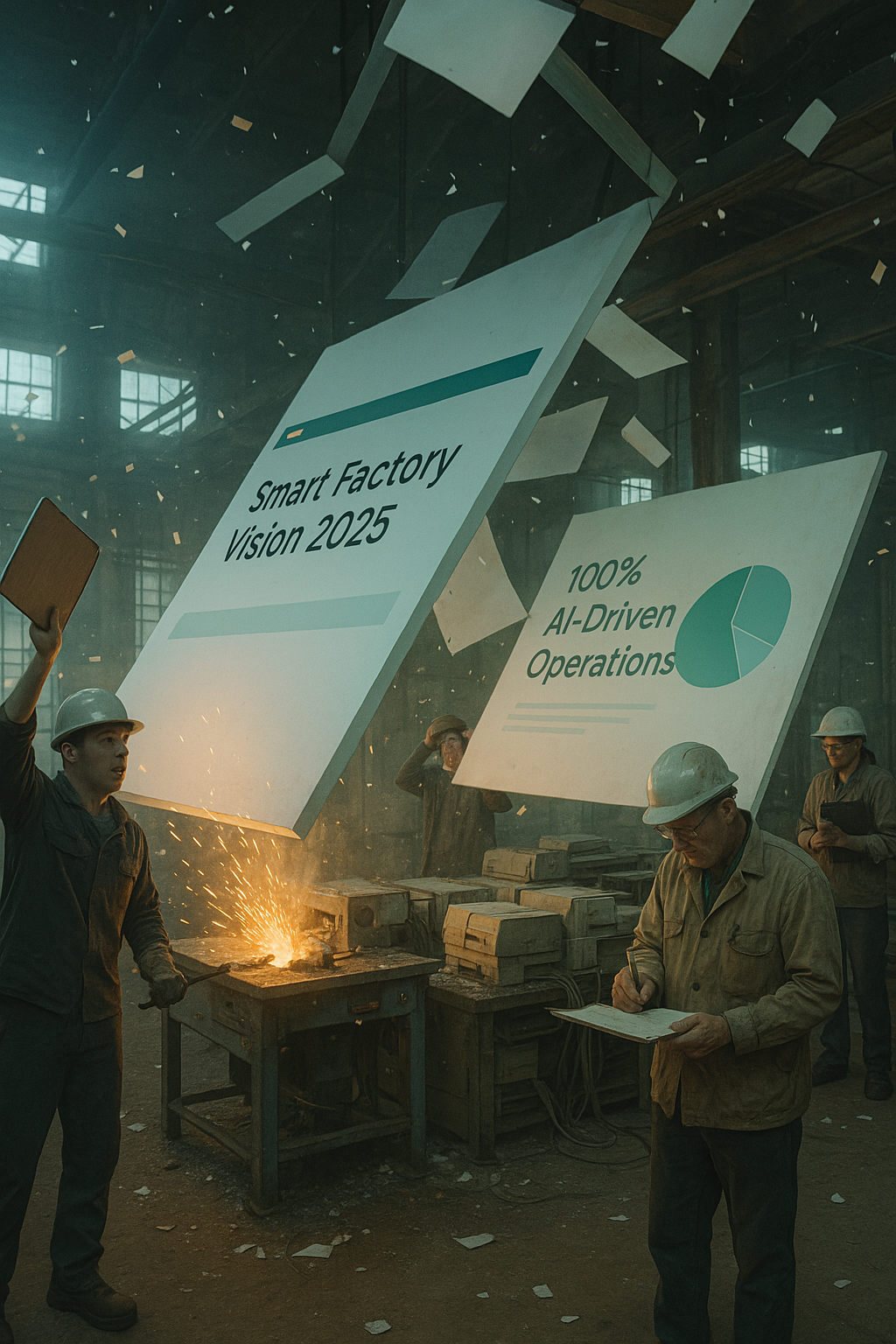
In the glossy decks shown at board meetings, your factory hums with smart sensors, predictive maintenance, and seamless human machine collaboration. Every process is optimized. Every worker wears connected gear. Every machine speaks to the cloud. But step onto the actual factory floor and you’ll find a different story. Dusty terminals, Excel sheets printed and pinned to walls, outdated machinery held together with cable ties, and Wi-Fi zones that end at the coffee machine. The digital transformation of industry has become a narrative success and an operational illusion.
Everyone talks about Industry 4.0. The term alone promises a revolution. It implies not just an evolution but a leap into a new era of industrial capability. But beneath the surface, many manufacturers are struggling to move beyond PowerPoint promises. The reality is that most factories are still stuck in the early days of automation, relying on legacy systems that were never designed to integrate, adapt, or scale. The dashboards are flashy but the data is still being collected on clipboards.
Executives love to talk digital. Consultants love to sell digital. Tech vendors love to market digital. But on the ground, in the noise and dust of actual production environments, workers are juggling analog workarounds to keep output moving. There is a growing disconnect between vision and reality and it is becoming a liability. You cannot plug AI into a factory that barely runs Ethernet. You cannot optimize a process you cannot even measure. And you definitely cannot claim to be future ready when your core systems belong to a decade that ended with flip phones.
So why the gap ? Part of the problem lies in how digital transformation is being sold. The focus is often on tools rather than outcomes, on systems rather than people. It is easier to invest in shiny new software than in messy cultural change or infrastructure upgrades. It is easier to build a digital twin than to retrain your operators. Companies prioritize the appearance of innovation over the friction of implementation. And when the PowerPoint looks good enough, no one wants to look under the hood.
Then there is the fear of disruption. Retooling a factory is not like updating an app. It is expensive, it is slow, and it carries real operational risk. Many manufacturers delay deep digital transformation because they simply cannot afford the downtime or the uncertainty. They build a layer of digital cosmetics on top of old systems and call it transformation. But a shiny UX on a fragile backend is not resilience. It is risk disguised as progress.
And yet the need is real. Markets are faster. Supply chains are more volatile. Margins are tighter. The industrial world does not just need digital tools, it needs them to work in context, in environments that are complex, physical, and deeply human. This means transformation has to start from the ground up. It has to prioritize interoperability, data integrity, workforce training, and long term thinking. Not just the glossy narrative but the gritty reality.
So yes, your PowerPoint says your factory is smart. It shows a sleek control room and a dashboard full of KPIs. But if your operators still write down production numbers by hand and your machines have not seen a firmware update since the iPod era, it is time to admit the gap. Because the future of industry will not be built in slide decks. It will be built on factory floors, one real upgrade at a time.

 English
  French